Colleges and Universities

Resolved during the term for higher education.

A student who disengages in October does not tell you until they fail to enroll in January. The instrument that would have caught it arrives at the end of the term.

HIGHER EDUCATION
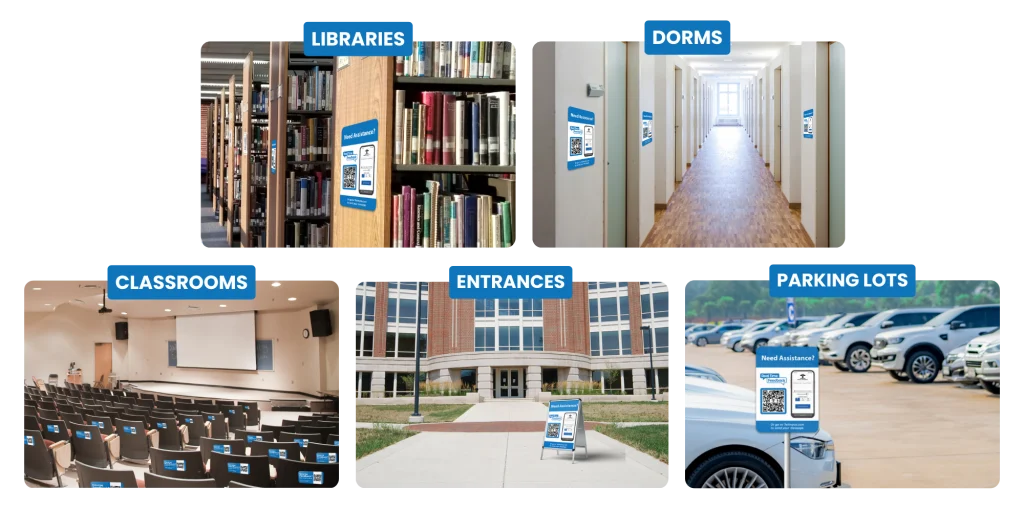
  • Residence hall codes
  • Dining hall and station prompts
  • Classroom, lab, and AV codes
  • Library and study spaces
  • Campus safety points and signage
  • Advising and services follow-up
  • Anonymous student and staff channel
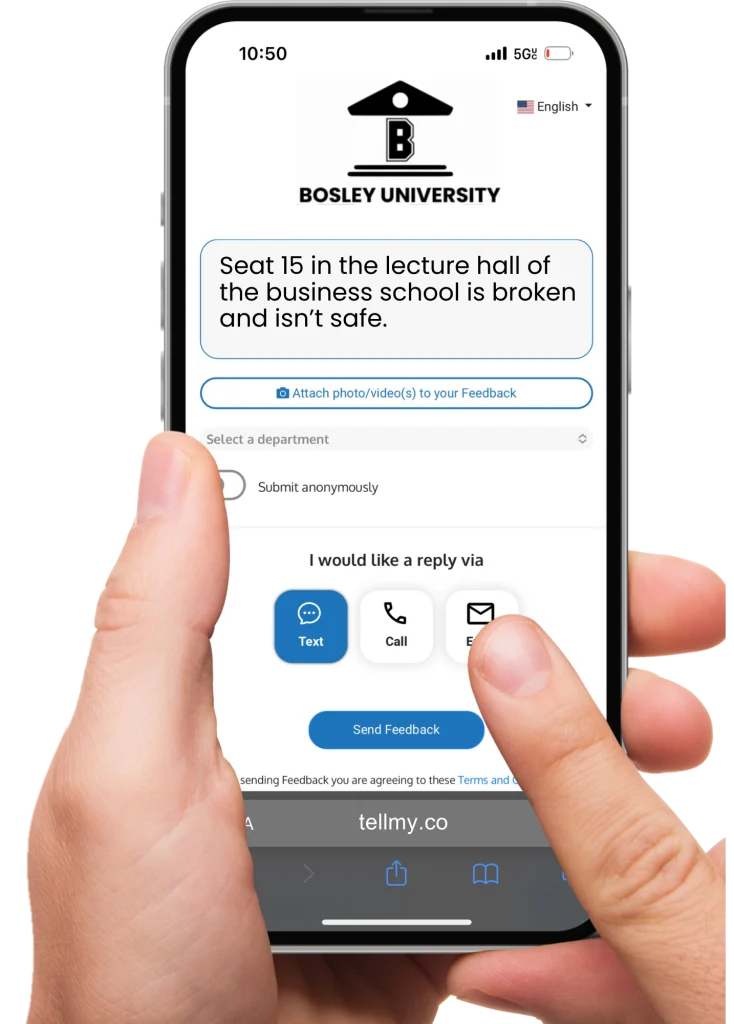
  • Mobile web app, no download

Every touchpoint routes to a named owner with a timestamp.

Where it breaks

Three things that cost you money in higher education.

01

End-of-term instruments arrive after the decision

The student who struggled with advising in week three has already formed a view about whether this institution works for them, long before the survey fields.

02

Students raise it with each other, not with you

Only one in twenty-six unhappy people raise it with the institution. The rest raise it on a group chat, and then in a transfer application.

Source: Esteban Kolsky, ThinkJar Research

03

Accreditation asks for evidence of response

Self-study requires a documented record of what students reported and what the institution did about it, across multiple terms.

How it works here

Capture, route, act. Configured for your operation.

  1. 01STEP 01

    Capture

    Codes in residence halls, dining, libraries, advising offices, and on campus signage. Students, families, and staff report in one tap.

  2. 02STEP 02

    Route

    A dining issue routes to dining services. A residence life concern routes to student affairs with the building attached and the reporter anonymous if they choose.

  3. 03STEP 03

    Act and invite

    The office resolves during the term while intervention still changes the outcome, and the record supports assessment and accreditation reporting.

Where we listen, and who acts

A signal nobody owns is just a notification.

Every listening point is tied to a location, and every location is tied to a named owner. That pairing is the whole mechanism.

WHERE WE LISTEN

  • Residence hall codes
  • Dining hall and station prompts
  • Classroom, lab, and AV codes
  • Library and study spaces
  • Campus safety points and signage
  • Advising and services follow-up
  • Anonymous student and staff channel
  • Mobile web app, no download

Codes are dynamic. Each one carries its own location, so the report arrives already knowing where it came from.

WHO NEEDS THE SIGNAL

  • Dining services

    Hall, station, and meal-period reports routed to the operator responsible for that hall

  • Residence life

    Building and floor concerns, with the reporter anonymous where they choose

  • Facilities and IT

    Classroom, lab, AV, and network faults reported from the room they occurred in

  • Campus safety

    Discreet concerns from anywhere on campus, including from students who will not approach an office

  • Advising and student affairs

    Service friction surfaced during the term, while intervention still changes persistence

  • Provost and institutional research

    A cross-departmental view and a documented record for assessment and accreditation

Modern stakeholder listening

The people closest to the problem are rarely the ones being asked.

VOICE OF THE EMPLOYEE

The digital suggestion box, rebuilt for real time.

Advisors, residence life staff, and dining teams notice a student disengaging weeks before the end-of-term instrument does.

Give them a private channel that takes seconds to use. Employees can surface ideas, operational concerns, process breakdowns, safety issues, and recognition for a colleague, anonymously where that is enabled. Every submission routes to a named owner, carries a status, and is closed out, then rolls up into the same reporting leadership already reads.

BEYOND LEGACY TEXT-IN REPORTING

One scan. Zero unnecessary friction.

Inbound text-to-report still asks the same thing it always did: remember a number or a keyword, stop what you are doing, open a messaging app, type the issue from a blank field, then describe where you are standing. Most people do not bother.

  • A short code asks the reporter to supply the context
  • A Trigger Code already carries the location and the context

Outbound messaging stays a valid channel for follow-up and confirmation. The friction being removed is on the way in.

What leadership receives

The signal matters today. The pattern matters tomorrow.

Individual moments are resolved on the floor. Read together across a month, they become the management agenda for higher education.

IN THE REPORT

  • Residence hall condition by building and floor, with repeat-report history
  • Dining themes by hall, station, and meal period
  • Classroom, lab, and AV failures tied to the room and the schedule block
  • Safety report volume and response time, held separately from service quality
  • Term-over-term movement on the same categories, for self-study and assessment
  • Faculty and staff-reported process breakdowns, anonymous where enabled

WHAT CHANGES IN THE BUSINESS

Persistence and yield

A student who struggled in week three has formed a view long before the end-of-term instrument fields. Reaching them inside the term is the only version that changes the enrollment decision.

Accreditation and assessment evidence

Self-study requires a documented record of what students reported and what the institution did about it, across multiple terms. That record is a by-product here, not a project.

Facilities prioritization

Deferred maintenance lists are long. Reported condition, ranked by frequency and by building, is a defensible way to order them.

Campus safety response

Anonymous reporting removes the reason most students give for saying nothing. The concern reaches safety in the same minute it is felt.

What matters most here

Most Relevant Capabilities for Higher Education

The full platform ships with every deployment. These are the capabilities that carry the weight in your operation.

Multi-Touchpoint Capture

Mobile web app, digital signage, dynamic QR codes, and kiosks. No download required.

Intelligent Routing

Every response reaches the person who can resolve it, with location and context attached.

Employee Feedback

A private channel for the people who see problems first. Ideas, safety concerns, breakdowns, and recognition, anonymous where enabled, with the same routing and accountability.

AI Sentiment Analysis

Automated classification, theme detection, and emerging-issue alerts across every response.

Executive Dashboards

Real-time visibility for leadership, timestamped accountability for operators.

Explore All Platform Capabilities

Feature spotlight

Second Chance Alert for higher education

Students return to the same offices every term. When a student who reported a problem books another advising appointment, the office knows the history.

  • Know the moment someone with prior negative feedback returns
  • Managers receive the original feedback and the prior response
  • Convert the return into a recovery moment before they leave again
SECOND CHANCE ALERT
NOW

Returning guest with prior issue

Your manager is alerted with the context needed to create a better experience while the guest is still on the property.

REAL TIME

return alerts

FULL

issue context

1:1

recovery moment

Our clients

Deployed and supported by Get Real Time Feedback.

Visitors gathered along the viewing window of a large aquarium exhibit
Georgia Aquarium logo

Georgia Aquarium

ATLANTA, GEORGIA

A high-volume attraction in our home market. Real-time guest, employee, and operational signal captured across the visit and routed to the team on the floor.

Client deployment delivered and supported by Get Real Time Feedback. The image above is a licensed aquarium photograph used to set the environment. It is not a photograph of this deployment.

REFERENCES

Additional client references, deployment detail, and reference calls are available on request as part of a procurement or evaluation process.

Request a reference

Supporting platform references

Operators who run the same platform in venues like yours.

These are deployments of the licensed platform rather than Get Real Time Feedback client engagements. They are published as evidence that the technology holds up at scale.

We needed a solution set up under a quick deadline, and within days they delivered a customized ready-to-use system. Their professionalism and attention to detail is world-class.

Matt Keller

Director of Information Technology, Dallas Stars

Run your own numbers

What is silence costing you?

Enter five numbers you already know. The model applies published research coefficients to your own inputs and returns a conservative range. Every figure below belongs to you, not to us.

2540,000
$5$500
$200$25,000
1.05.0
1%25%

YOUR ESTIMATE

Enter your numbers to see your estimate.

Move any slider, or type a value into any field. Nothing is calculated and no figure is shown until you do. Every result is a conservative range built from your own inputs.

This model applies published third-party research coefficients to the figures you entered. It is an illustrative estimate of exposure, not a projection of results from Get Real Time Feedback. Complaint rate: Esteban Kolsky, ThinkJar Research. Word-of-mouth coefficient: nine people told, 50 percent deterred. Defection band: 25 to 50 percent of silent detractors. The Luca rating-to-revenue coefficient is derived from independent restaurants and is not applied to this sector. The revenue driver shown is retention of repeat users, modeled at a 5 to 15 percent recovery rate.

Walk me through what to do about it

Move any slider to build your analysis first.

Know. Now.

Run your numbers, or book thirty minutes and we will walk your leadership through the platform and the ROI model for higher education.